
Construction Expense &Ledger Automation
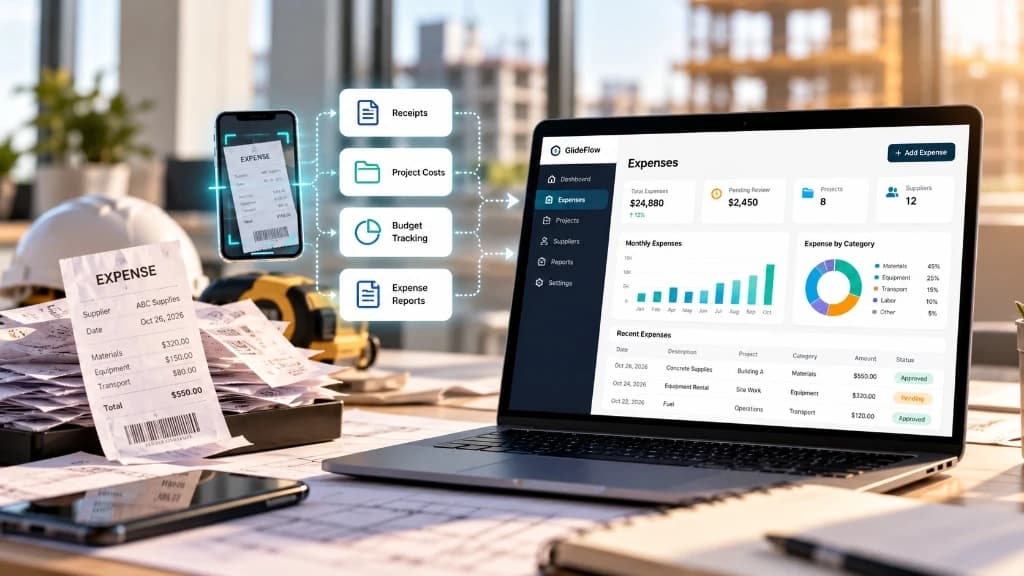
GlideFlow captures on-site voice notes, receipts, and invoices into structured ledger records, reducing expense processing time by 70%.


Fewer incomplete records
Monthly staff capacity released
Reduction in manual data entry errors

Site Information Was Difficult to Turn into Reliable Records
Construction work generates a continuous flow of operational and financial information. Materials are purchased, suppliers issue receipts, site managers send updates, and employees report expenses while working across different locations. For the client, much of this information arrived in unstructured formats. Office staff had to interpret messages, read receipts, identify the relevant project, and manually enter details into ledgers or spreadsheets.
Expense information accumulated before being entered into records.
Employees repeatedly transcribed information from receipts and messages.
Project expenses were not always categorized consistently.
The contractor wanted to simplify recordkeeping while maintaining the checks required for reliable financial records.

A Smarter, More Structured Workflow
GlideFlow analyzed the journey of expense information from the construction site to the office and designed a workflow around the client's existing processes.
Voice message processing
Supported voice notes are transcribed and converted into structured expense or site-update entries.
Receipt information extraction
Receipt images are processed to capture relevant information, such as supplier name, date, total amount, and other available fields.
Project and category organization
Entries are organized by project, supplier, date, and expense category using agreed rules.
Validation and exception handling
Unclear amounts, missing fields, and records requiring confirmation are flagged for review.
Digital ledger integration
Validated information can be transferred into the client's spreadsheet, ledger, or supported accounting system.
From Manual Work to Real Impact
| Performance Indicator | Before GlideFlow | After GlideFlow | Improvement |
|---|---|---|---|
| Manual data-entry time | 100 hours/month | 30 hours/month | 70% reduction |
| Average expense processing time | 10 minutes | 3 minutes | 70% reduction |
| Incomplete expense records | 50/month | 20/month | 60% reduction |
| Expense records processed monthly | 600 | 600 | Same volume, less effort |
Turning Manual Expense Tracking Into Operational Clarity
The client gains a more structured process for capturing expense information and maintaining project records. Employees spend less time transcribing details and more time reviewing exceptions, monitoring budgets, and supporting construction operations.
Reducing data-entry delays can also improve the availability of expense information for project managers.
Ready to automate your document-heavy operations?
Explore how GlideFlow engineers enterprise AI workflows tailored to your specific industry, compliance requirements, and legacy systems.
More Production Case Studies
See all →Infrastructure Tender Submission Automation
How GlideFlow streamlined tender preparation for infrastructure operations, reducing document processing effort by 60% with intelligent automated verification.
AI Appointment Booking For Healthcare
How GlideFlow deployed autonomous AI voice agents for healthcare clinics, handling 24/7 patient scheduling and reducing missed appointment calls by 85%.
Lead Management and Sales Follow-Up
GlideFlow automates lead management across web, email, and social channels, cutting first-response time by 93.8% and driving a 95% follow-up completion rate.